First time over the bar, sailing in the ocean, navigating at night ...Oh my!
Published 8:21pm on 5 Dec 2025
By Lynda Romeo
My spring repositioning sail from Hayden Bay Marina to Seattle, Washington took place over four memorable days in April 2025. The voyage combined the beauty and unpredictability of the Pacific Northwest with the excitement and nervousness I felt as one of the four souls aboard Ranidan. Newly purchased by Lloyd, she was being taken to her new home in Seattle. There to assist: Captain Tom, a veteran seaman, Chris and myself.
Day 1 Down the Columbia River to Astoria
We departed Hayden Bay early on the morning of April 21st, catching the ebbing tide to make good time down the Columbia River. The day greeted us with cloudy skies and intermittent showers, a classic Northwest mix of mist and gray, but visibility remained good and the winds were light.
Along the way, we were treated to a spectacular sight — a large pod of sea lions scattered along the channel markers and sandbars. Their playful antics and loud barking were a highlight of the day and reminded us just how alive the Columbia is with wild life.
By late afternoon, we arrived at Astoria Marina, where we secured the boat for the night. After a long day on the river, the crew enjoyed a warm meal and a walk along Astoria's historic waterfront before turning in, ready for the next leg of the journey.
Day 2 Crossing the Bar and Heading Up the Coast
We cast off at 6:30 a.m. to time our arrival at the Columbia River Bar for 8:30 a.m., when the tide and weather promised the best crossing conditions. Known as one of the most challenging bars in the world, the Columbia's reputation precedes it — but on this morning, the seas were calm at about two feet, offering an ideal passage.
Since this was my first time crossing the bar, I asked Captain Tom when we would finally reach it. He smiled and replied, "we're in the middle of it". It was a moment of quiet surprise and relief — the crossing I'd anticipated so much had turned out to be as smooth as could be hoped for.
Once out into the Pacific, our trek up the coast began in earnest. The day unfolded beautifully, with fair conditions, whale sightings and light winds. We kept a sharp watch for crab pots, which dotted our course. For most of the day, we spotted and avoided them all — until late afternoon, when Lloyd, just starting his watch, hit one straight on.
That's when our fire drill began. Fortunately, Lloyd reacted instantly and cut the engine. Captain Tom and Chris sprang into action, quickly devising a plan to free us. They caught one of the floats with the boat hook off the stern, securing it to a winch line so we could haul it closer and see how it was tangled — and, most importantly, whether the line was wrapped around the prop.
After a bit of careful forward and reverse maneuvering, it became clear that we'd need to strap a knife to our second boat hook to saw through the line. After some tense minutes, we were finally free. A quick test of forward and reverse showed no apparent long-term damage. With a collective sigh of relief, we resumed our northbound course, a little wiser — and a lot more respectful of crab gear.
Nightfall at Sea
As evening settled in, the Pacific transformed. The sky cleared briefly to reveal a brilliant canopy of stars, and the bioluminescent waves put on a shimmering show. It was a magical scene — but the calm didn't last long.
By midnight, the rain returned and the seas began to build, soon reaching 10-12 feet. We were heading directly into the wind, the waves were pounding our port, sending the sturdy 42' Hallberg-Rassy pitching and slamming hard through the night. For 5 hours as we crested a swell, it felt as though a giant hand grabbed the hull and threw it back down with a shuddering crash.
We rotated through three-hour watches, and any attempt at rest meant sleeping on the cabin sole near the centerline, where the motion was least violent. Even the seasoned sailors aboard rated the night a 7 to 8 on a scale of 10 for difficulty. It was a long, hard night, one that tested both the crew and the vessel — but by morning, we had weathered it together.
Day 3 Straits of Juan de Fuca and Port Townsend
Dawn found a tired and hungry crew, having missed dinner the night before while remaining vigilant amid the rough conditions. By noon, we reached the Strait of Juan de Fuca through the Hole in the Wall shortcut, which shaved about 1.5 hours off our journey.
Despite the time saved, strong currents slowed our progress, and it took us two hours longer than planned to arrive at Port Townsend. By the time we reached the marina at 11:30 p.m., darkness and unfamiliar waters made it challenging to identify the correct navigation aids and the entrance to the marina.
Captain Tom wisely suggested testing the boats maneuverability before attempting to enter the marina. We discovered that reverse was sluggish, a serious concern for stopping and docking in the cramped marina. After discussion about pushing on through another night or attempting to dock, Captain Tom took the helm, drawing on his experience. With all hands on deck, we cautiously worked together and maneuvered safely into the tight berth.
We celebrated our successful arrival at 1 a.m. with cider and snacks, grateful for the day behind us and the challenges overcome.
Day 4 Final Leg to Seattle
At first light, Lloyd called a diver to check the prop. The diver removed loosely tangled lines and ensured the boat was ready for the final leg. We departed at 10 a.m., taking advantage of favorable currents.
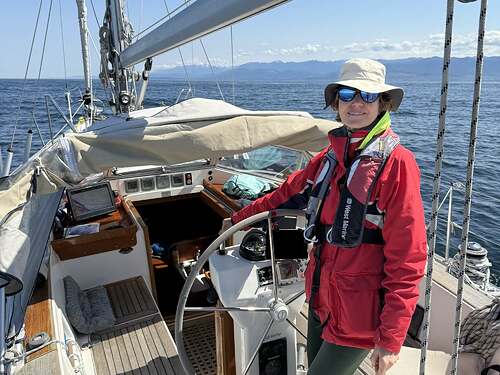
The day was beautiful — blue skies, calm water, clear views of the coast range with snow-capped peaks and eagles overhead. I was at the helm enjoying the serenity, when I heard a boat approaching fast from behind. To my surprise, it was an official vessel hailing us to stop! After a moment we realized it was Border Patrol. They asked us questions about our journey, persons aboard, etc. for about 15 minutes...satisfied they bid us good day.
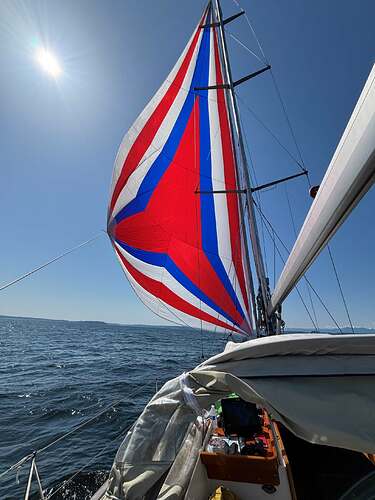
Soon the wind picked up nicely, allowing us to finally sail using the gennaker for 2 to 3 hours, reaching speeds of 8 to 10 knots. Later, as the wind shifted, we returned to motoring. Before we knew it Seattle came into view, bringing the four-day adventure to a successful conclusion.
It was a journey that tested our skills, patience, and teamwork — but the combination of stunning scenery, wildlife encounters, and seamanship challenges forged a bond between the sailors which made this repositioning cruise one to remember.